8. Adding numbers back
In this lesson: when you do know some numbers, feed them in and get quantitative bounds back — "the outflow settles at exactly 2" — without giving up the qualitative guarantees.
The middle ground
Pure qualitative reasoning uses no numbers; pure numerical simulation needs all of them. Real problems live in between: you often know a few values (the tap rate, a capacity) but not others (the exact drain shape). Semi-quantitative reasoning takes whatever numbers you have and squeezes out the tightest bounds it soundly can.
The key move is to give your landmarks numeric values. Recall that a
Landmark is a name that may carry a number. Attach numbers, and the
library can reason about magnitudes and even time, not just order.
import qrlib as qr
from qrlib import Landmark, Qdir, TimeTag

m = qr.Model("bathtub")
m.variable("amount",  landmarks=(Landmark("0", 0.0), Landmark("FULL", 10.0)))
m.variable("level",   landmarks=(Landmark("0", 0.0), Landmark("TOP", 5.0)))
m.variable("outflow", landmarks=(Landmark("0", 0.0), Landmark("OMAX", 3.0)))
m.variable("inflow",  landmarks=(Landmark("0", 0.0), Landmark("IF", 2.0)))
m.variable("netflow", landmarks=(Landmark("0", 0.0),), unbounded=True)
m.constrain(qr.MPlus("amount", "level",  cvals=(("0", "0"), ("FULL", "TOP"))))
m.constrain(qr.MPlus("level",  "outflow", cvals=(("0", "0"), ("TOP", "OMAX"))))
m.constrain(qr.Add("netflow", "outflow", "inflow"))
m.constrain(qr.Deriv("amount", "netflow"))
m.constrain(qr.Constant("inflow"))
initial = m.state(time=TimeTag.POINT,
                  amount=("0", Qdir.INC), level=("0", Qdir.INC),
                  outflow=("0", Qdir.INC), inflow=("IF", Qdir.STD),
                  netflow=(("0", "+inf"), Qdir.DEC))
result = qr.qsim(m, initial)
Refining a behavior
Pick the behavior where the drain keeps up and the tub settles below the brim,
and refine it. refine propagates the numeric bounds through the
constraints along that one behavior, to a fixpoint:
below = next(b for b in result.behaviors()
             if b.terminal is qr.TerminalClass.QUIESCENT
             and result.graph.nodes[b.node_ids[-1]].model
                   .spaces[0].describe(b.states[-1]["amount"].mag) != "FULL")

refinement = qr.semiquant.refine(result.graph, below)
print(refinement.feasible)      # True

for i, bounds in enumerate(refinement.bounds):
    o = bounds["outflow"]
    n = bounds["netflow"]
    print(f"state {i}:  outflow in [{o.lo}, {o.hi}]   netflow in [{n.lo}, {n.hi}]")
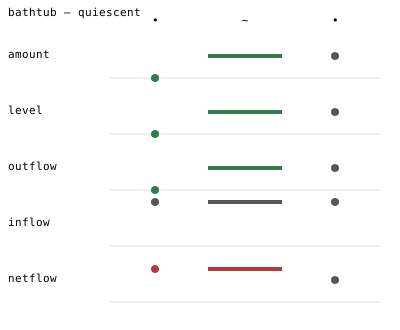
state 0:  outflow in [0.0, 0.0]   netflow in [2.0, 2.0]
state 1:  outflow in [0.0, 2.0]   netflow in [0.0, 2.0]
state 2:  outflow in [2.0, 2.0]   netflow in [0.0, 0.0]
Look at the last line. We never told the library the equilibrium outflow. But
it derived that at equilibrium the outflow settles at exactly 2.0 — and
the net flow at exactly 0. The reasoning is airtight: at an equilibrium the
net flow is zero, and netflow + outflow = inflow with inflow = 2 forces
outflow = 2. A qualitative fact (equilibrium ⇒ net flow zero) plus one
number (the inflow) yields a precise numeric answer.
Here is that refined behavior as a timeline; the numeric bounds ride along under each qualitative band:
Numbers can refute qualitative behaviors
Semi-quantitative reasoning does something the purely qualitative graph
cannot: it can prove a qualitatively-consistent behavior numerically
impossible. In this tub, OMAX = 3 is larger than IF = 2 — the drain
can outpace the tap at the brim — so the overflow behavior, though it passes the
sign checks, is refuted the moment you add the numbers:
overflow = next(b for b in result.behaviors()
                if b.terminal is qr.TerminalClass.DOMAIN_EXIT)
print(qr.semiquant.refine(result.graph, overflow).feasible)   # False
refine returns feasible=False because reaching the brim while still rising
would need netflow > 0 there, i.e. outflow < 2; but at the brim the level
is TOP and the outflow is OMAX = 3 > 2. Contradiction. The numbers rule it
out — exactly the semi-quantitative payoff. (This same check runs batched
over many states at once in qrlib.tensor.interval, for when you have a whole
graph to screen.)
Time bounds and envelopes
Refinement also bounds when things happen — the classic result is "the tank
reaches full between t = 1.0 and t = 1.9." Tight time bounds need one more
ingredient: envelopes, numeric lower/upper functions that bracket the
otherwise-unknown monotonic relationships (how fast, exactly, does the drain
speed up with depth?). Envelopes are an intermediate topic; the module
docstring in qrlib/semiquant.py walks through them and the mean-value-theorem
time reasoning they enable.
The through-line
You did not abandon the qualitative model to get numbers — you enriched it. Everything the qualitative analysis proved still holds, and the numbers only ever tighten the picture or refute a behavior. That layering — sound qualitative core, optional numeric refinement on top — runs through the whole library.
Exercises
- Change
IFto4.0(a faster tap, now greater thanOMAX = 3) and re-runrefineon the overflow behavior. Is it feasible now? Explain why the overflow became possible. - From the refined below-brim equilibrium, read off the bounds on
levelandamountat the final state. Are they pinned as tightly asoutflow? Why or why not? (Hint: what does the model know about the shape oflevel = f(amount)?) - Explain the difference between the coverage oracle (Lesson 7) refuting a
trajectory and
refinerefuting a behavior. What does each one use as evidence?