5. Cycles and the spring
In this lesson: a system that loops forever, the alternation of point and interval time, and how to read a behavior as a timeline.
A different kind of system
The bathtub settled down. Not everything does. A frictionless spring — a mass bobbing on a spring with no friction — swings back and forth forever. Its behavior isn't a tree that ends; it's a loop.
Here's the model. Position x, velocity v, and acceleration a, related by
the physics x'' = -x (the acceleration always points back toward center):
import qrlib as qr
from qrlib import Qdir, TimeTag

m = qr.Model("spring")
for name in ("x", "v", "a"):
    m.variable(name, landmarks=("0",), unbounded=True)   # can be -, 0, or +

m.constrain(qr.Deriv("x", "v"))    # velocity is the rate of position
m.constrain(qr.Deriv("v", "a"))    # acceleration is the rate of velocity
m.constrain(qr.Minus("x", "a"))    # a = -x  (the restoring force)

initial = m.state(
    time=TimeTag.POINT,
    x=("0", Qdir.INC),            # at center, moving in the + direction
    v=(("0", "+inf"), Qdir.STD),  # at peak speed
    a=("0", Qdir.DEC),
)
The practical default keeps landmark discovery off (you'll meet the classic alternative in Lesson 6):
result = qr.qsim(m, initial)
(behavior,) = result.behaviors()
print(behavior.terminal)          # TerminalClass.CYCLE
print(len(behavior.states))       # 9
One behavior, and it's a CYCLE — it returns to a state it has already
visited and closes the loop.
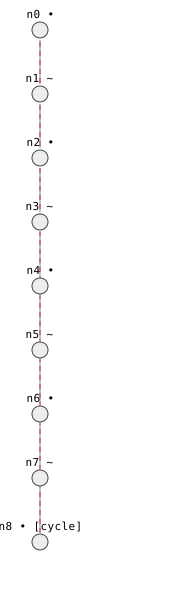
Read it top to bottom: the state marches through the quarter-swings of one full oscillation, and the dashed edge at the bottom loops back to the start. That dashed line is the library saying "and then it repeats, forever."
Point time and interval time
Look closely at the states and you'll notice they alternate between two kinds of time. This is fundamental to how QSIM represents change:
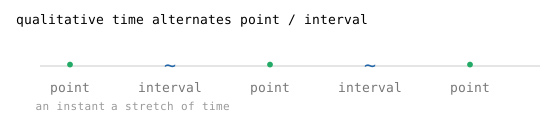
- A point (•) is an instant — a distinguished moment, like the exact instant the spring reaches its rightmost point and its velocity is zero.
- An interval (~) is a stretch of time between two instants — like the whole sweep from center to the rightmost point.
Time alternates point, interval, point, interval… because the interesting
things (reaching a landmark, a direction reversing) happen at instants, and
between them the system just moves through a stretch. A state's
time tag tells you which it is:
from qrlib import TimeTag
for i, state in enumerate(behavior.states):
    kind = "•" if state.time is TimeTag.POINT else "~"
    print(i, kind)
Reading a behavior as a timeline
The graph shows the branching structure; a timeline shows what each variable does along one behavior. The library renders one directly:
from qrlib.viz import timeline_svg
svg = timeline_svg(result.graph, behavior)
assert svg.startswith("<svg")
Notebook and host applications can display or persist the returned string. Here is the committed rendering:
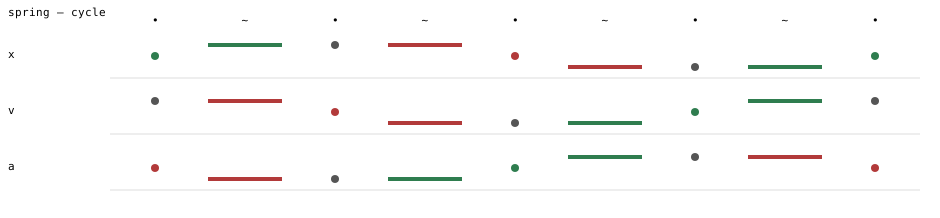
Each row is a variable; each column is a state (• point, ~ interval). The
height of a mark is the variable's magnitude, and its colour is its direction
(red falling, green/grey steady, blue rising). Trace the x row and you'll
see the classic shape of an oscillation: up to a peak, back through center to
a trough, and back — one full period, then the cycle closes.
Finding cycles programmatically
You don't have to eyeball it. The query helpers locate loops for you:
from qrlib.analysis import queries
loops = queries.cycles(result.graph)
print(len(loops))        # 1
print(len(loops[0]))     # 9  — the states in the loop
The query works in either representation: tree simulations record a
cycle_target, while attainable-envisionment simulations encode recurrence
as graph edges and the query extracts one concrete loop from each recurrent
strongly connected component.
Exercises
- Run the spring and print the
xvalue (magnitude and direction) at every state. Identify which state is the rightmost point of the swing (wherexis at its most positive andvhas just become zero). - The velocity
vpasses through zero twice per period. At those two instants, what is the positionxdoing? (Use the timeline or the printed states.) - A pendulum with friction slowly loses amplitude and eventually stops. Would
you expect its behavior graph to end in a
CYCLEor aQUIESCENTstate? Why?