4. Your first simulation
In this lesson: run
qsim, read the tree of possible behaviors, and understand how each one ends.
Running the simulation
With the model and initial state from Lesson 3, one call does the work:
import qrlib as qr
from qrlib import Qdir, TimeTag

# ... build `m` and `initial` as in Lesson 3 ...

result = qr.qsim(m, initial)
print(result.status)                 # SimStatus.COMPLETE
print(len(result.behaviors()))       # 3
qsim explores every qualitatively consistent way the system can evolve
from the initial state, and returns a SimResult. The default
SimConfig.practical() profile leaves new steady values unnamed and merges
structurally unobservable direction chatter, preserving coverage while
keeping common models bounded. In tree mode, result.behaviors() is the list
of complete behaviors, each a path from the start to an ending.
For large results, result.iter_behaviors(limit=...) streams paths without
materializing the tuple. With attainable-envisionment merging enabled, these
accessors return compact representatives—one path per terminal and one loop
per recurrent component—rather than exponentially expanding every simple
path through the merged graph.
The three bathtub behaviors
for b in result.behaviors():
    print(b.terminal, "  in", len(b.states), "states")
TerminalClass.QUIESCENT     in 3 states
TerminalClass.DOMAIN_EXIT   in 3 states
TerminalClass.QUIESCENT     in 3 states
Three outcomes — exactly the ones you reasoned out by hand in Lesson 1:
- the level settles below the brim (a quiescent equilibrium),
- it settles exactly at the brim (another equilibrium),
- it overflows — the water amount must leave the top of its quantity
space, which the library reports as a
domain_exit(the system has left the range the model describes).
Here is the whole behavior graph again, now that you know how to read it:
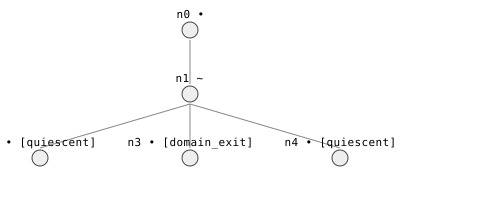
The root (top) is the initial state. It flows into one intermediate state, which then branches into the three endings. Branching is the library saying "from here, more than one future is qualitatively consistent."
Terminal classes: how a behavior ends
Every behavior ends in a terminal class that tells you why it stopped:
| Terminal | Meaning |
|---|---|
QUIESCENT |
Everything went steady — an equilibrium. The system stays here forever. |
CYCLE |
The state repeats an earlier one — a loop (you'll see this with the spring in Lesson 5). |
DOMAIN_EXIT |
A variable must leave its quantity space (e.g. the tub overflows past FULL). |
REGION_EXIT |
A declared operating region is left without an applicable transition. |
DIVERGENT |
A variable runs off to infinity (the t → ∞ limit). |
DEADEND |
No consistent successor survived — the state was spurious. Reported, never hidden. |
TRUNCATED |
A resource limit stopped exploration here (not a real ending — see Lesson 6). |
You can ask summary questions with the analysis.queries helpers:
from qrlib.analysis import queries

census = queries.terminal_census(result.graph)
print(census)
# {TerminalClass.QUIESCENT: 2, TerminalClass.DOMAIN_EXIT: 1}
Looking inside a behavior
A behavior is a sequence of states. You can inspect what each variable is doing at each step:
overflow = next(b for b in result.behaviors()
                if b.terminal is qr.TerminalClass.DOMAIN_EXIT)

for state in overflow.states:
    amount = state["amount"]
    space = m.variables["amount"].space
    print(space.describe(amount.mag), amount.dir.name)
0 INC
(0, FULL) INC
FULL INC
The overflow behavior: the amount starts at 0 rising, passes through the
interval (0, FULL), and arrives at FULL still rising — which is why it
overflows. Read that last line as the punchline: still increasing when it
hits the top means it can't stop, so it leaves the tub.
Determinism
Given the same model and configuration, qsim produces the same graph every
time — the ordering of behaviors and states is fixed and reproducible. You can
rely on that in tests and in figures.
Exercises
- Run the bathtub simulation and print, for each of the two
QUIESCENTbehaviors, the final direction of every variable. (They should all be steady — that's what "quiescent" means.) - The overflow behavior reaches
FULLwhile stillINC. What would it mean, physically, if a behavior reachedFULLwhileSTD? Which terminal class would that be instead? - Use
queries.terminal_censuson your two-drain model from Lesson 3's exercises. Did adding a drain change the set of possible outcomes?