1. What is qualitative reasoning?
In this lesson: why you can predict a system's behavior without knowing its numbers, and the single promise that makes this library trustworthy.
The bathtub you can reason about in your head
Picture a bathtub. The tap is running at a steady rate, and the drain is open. Will the water overflow, settle at some level, or drain away?
You already know the answer depends on a race: how fast water comes in versus how fast it drains out. And you know one more thing without being told a single number — the drain gets faster as the water gets deeper. So as the tub fills, the outflow climbs to meet the inflow, and the level either steadies out (if the drain can keep up before the tub is full) or the tub overflows (if it can't).
Notice what you just did. You reasoned about:
- directions — the water level is rising; the outflow is increasing;
- orderings — is the inflow more than, equal to, or less than the maximum the drain can manage?
You never used a number. You used signs (rising / falling / steady) and order (bigger / smaller / equal). That is qualitative reasoning, and this library automates it.
Why bother, when we have real simulators?
Ordinary (quantitative) simulation needs exact numbers: the tap rate, the drain coefficient, the tub's shape. Give it those, and it predicts one future — the trajectory for those numbers.
Qualitative reasoning answers a different, often more useful question:
Given only how the parts relate, what are all the qualitatively distinct things that can happen?
That's valuable when you don't have exact numbers, when you want to be sure you haven't missed a failure mode, or when you want to explain why a system behaves as it does rather than just watch it. For the bathtub, the answer is a set of three outcomes — settle below the brim, settle exactly at the brim, or overflow — and the library derives all three from the structure alone.
The one promise (and its one catch)
Here is the guarantee that makes the whole approach trustworthy, stated plainly:
Every behavior the real system can actually exhibit will appear in the library's output.
This is called guaranteed coverage. It applies to systems satisfying the model's assumptions, with valid filter premises and a complete simulation. A resource-limited, truncated graph does not establish coverage of every future. Lesson 7 explains how to check concrete trajectories and the assumptions at the numeric-to-qualitative boundary.
The catch — and it is important — runs the other way:
The output may also contain extra behaviors that no real system exhibits. These are called spurious behaviors.
So the library is like a careful witness who promises to name everyone who could have been at the scene, knowing the list might include a few innocents. It never misses the culprit; it may over-include. Lessons 6 and 7 are about living with this honestly — pruning spurious behaviors where we soundly can, and never claiming more than the guarantee allows.
This asymmetry has a precise consequence you'll use throughout:
- A claim about all behaviors ("the tub never runs dry") can be proven — if it holds for every behavior in the (over-complete) output, it certainly holds for the real ones.
- A claim about some behavior ("there exists a way for it to overflow") is only suggested — the witnessing behavior might be spurious.
What a "behavior" looks like
Before the next lesson, here's the shape of what you're working toward. The library turns a model into a behavior graph: a tree (sometimes with loops) whose paths are the possible behaviors. Here is the real one for the bathtub, produced by the library:
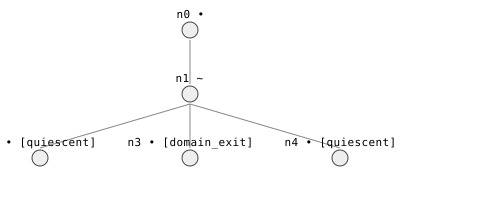
Read it top to bottom: the system starts at the root, moves to an
intermediate state, then splits into three endings — two quiescent
(settled) equilibria and one domain_exit (the overflow, leaving the
model's valid range). You'll learn to build this graph yourself in Lesson 4.
Exercises
- Think of another everyday system (a cup of coffee cooling, a savings account earning interest, a car braking to a stop). List the directions and orderings you'd reason about to predict its behavior — without numbers.
- For the bathtub, which of these is a universal claim (provable) and which is existential (only suggested)? (a) "The water level never decreases." (b) "There is a scenario where the tub overflows."
- In one sentence, explain to a friend why a tool that sometimes reports extra behaviors can still be more trustworthy than one that reports a single exact trajectory.