2. Quantities and values
In this lesson: how the library represents a quantity when it refuses to use exact numbers — with landmarks, intervals, and a direction.
Landmarks: the values that matter
When you reason about the bathtub, a few special water levels matter: empty (zero) and full (the brim). Everything else is just "somewhere in between." These special values are called landmarks.
A landmark is really just a name. It may optionally carry a number (we'll use that in Lesson 8), but qualitative reasoning uses only the name and the order of the landmarks.
import qrlib as qr

empty = qr.Landmark("0")
full = qr.Landmark("FULL")
Quantity spaces: landmarks in order
A quantity space is a list of landmarks in increasing order. It's the set
of qualitatively distinct values a variable can take. For the bathtub's water
amount, the space is just 0 < FULL:
space = qr.QuantitySpace((qr.Landmark("0"), qr.Landmark("FULL")))
# or, more briefly, using bare names:
space = qr.QuantitySpace(("0", "FULL"))
A value in this space is either at a landmark or strictly between two of
them. So amount can be:
- at
0(empty), - in the interval
(0, FULL)(partly full), - at
FULL(brim-full).
Some quantities have no natural top or bottom — a net flow can be as positive
or as negative as you like. Mark those ends unbounded, which adds
conceptual -inf / +inf endpoints:
netflow_space = qr.QuantitySpace(("0",), lower_unbounded=True, upper_unbounded=True)
# effective landmarks:  -inf < 0 < +inf
Here is the amount space drawn out. The library assigns each qualitative
value an integer rank — even ranks land on a landmark, odd ranks land
between two — so that "is this bigger?" becomes plain integer comparison:
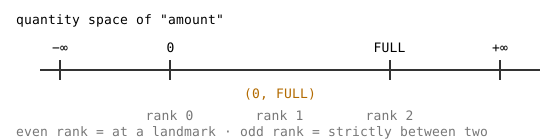
You rarely touch ranks directly, but it's good to know the rule: even = at a landmark, odd = in an interval.
space = qr.QuantitySpace(("0", "FULL"))
print(space.rank_of("0"))            # 0  (at the first landmark)
print(space.rank_between("0", "FULL"))  # 1  (the interval between them)
print(space.rank_of("FULL"))         # 2  (at the second landmark)
print(space.describe(1))             # "(0, FULL)"
Direction: which way it's moving
Knowing where a quantity is isn't enough; we also need to know which way
it's heading. That's the qualitative direction (Qdir), one of:
Qdir.INC— increasing (↑)Qdir.STD— steady (·)Qdir.DEC— decreasing (↓)
(The library's sign of a direction is -1, 0, +1 — the same signs you'd
use by hand.)
Putting it together: a qualitative value
A qualitative value (QVal) is a magnitude and a direction. "The tub
is partly full and filling" is the interval (0, FULL) paired with INC:
from qrlib import Qdir, QVal

space = qr.QuantitySpace(("0", "FULL"))
partly_full_and_rising = QVal(space.rank_between("0", "FULL"), Qdir.INC)
print(partly_full_and_rising.describe(space))   # "(0, FULL)↑"
That little string — (0, FULL)↑ — is the whole idea in miniature: an
ordinal position plus a trend. A complete snapshot of a system is just one
of these for every variable, which is what the next lessons assemble into a
state.
Why this representation is the point
By throwing away exact numbers and keeping only landmarks, order, and
direction, we make the set of possible situations finite and small. The
bathtub's amount has exactly three qualitative magnitudes, not infinitely
many real ones. That finiteness is what lets the library enumerate all
behaviors in Lesson 4 — something impossible if every real number were a
distinct case.
Exercises
- Write the quantity space for the angle of a pendulum that swings between a leftmost and rightmost point through a center. How many qualitative magnitudes does it have? (Hint: name the three landmarks.)
- Using
QuantitySpaceandQVal, build anddescribethe value "a temperature that is above freezing and falling," with landmarksFREEZE < BOIL. - A variable's space is
("0",)with both ends unbounded. List its effective landmarks and say how many qualitative magnitudes it has. (Check yourself withspace.num_ranks.)