3. Constraints and models
In this lesson: how to describe the way a system's parts relate — using a small vocabulary of constraints — and assemble them into a
Model.
A system is its relationships
The bathtub's behavior comes entirely from how its quantities relate:
- the level rises and falls with the amount of water;
- the outflow rises and falls with the level (deeper water drains faster);
- the net flow is the inflow minus the outflow;
- the amount changes at a rate equal to the net flow;
- the inflow is held constant.
Each of those is a constraint. Qualitative reasoning has a small, reusable vocabulary for them.
The constraint vocabulary
| Constraint | Meaning | Bathtub use |
|---|---|---|
MPlus(x, y) |
y increases whenever x does (some increasing function y = f(x)) |
level ↔ amount, outflow ↔ level |
MMinus(x, y) |
y decreases whenever x increases |
— |
Add(x, y, z) |
x + y = z |
netflow + outflow = inflow |
Mult(x, y, z) |
x · y = z |
— |
Minus(x, y) |
y = -x |
— |
Deriv(x, y) |
y is the rate of change of x (y = dx/dt) |
amount's rate is the netflow |
Constant(x) |
x never changes |
inflow is fixed |
The two you'll meet most are MPlus and Deriv.
MPlus (monotonically increasing) is the workhorse. It says "these two
move together" without committing to a formula. MPlus("amount", "level")
means only that a deeper tub holds more water and vice versa — true whether
the relationship is linear, quadratic, or some messy real tub shape. That
looseness is exactly what lets one qualitative model stand for a whole family
of real systems.
Deriv (integration) connects a quantity to its rate. Deriv("amount", "netflow") says the water amount rises when the net flow is positive, falls
when it's negative, and holds steady when it's zero — the qualitative version
of "integrate the net flow to get the amount."
Corresponding values
Monotonic constraints can record landmark pairs known to line up. For the bathtub, an empty tub has zero level, and a brim-full tub is at its top level:
qr.MPlus("amount", "level", cvals=(("0", "0"), ("FULL", "TOP")))
Those cvals (corresponding values) say "when amount is 0, level is 0;
when amount is FULL, level is TOP." They pin the landmarks together so the
reasoning stays tight.
Building the bathtub model
Now assemble it. A Model collects variables (each with its quantity space)
and constraints:
import qrlib as qr
from qrlib import Qdir, TimeTag

m = qr.Model("bathtub")

# variables and their quantity spaces
m.variable("amount",  landmarks=("0", "FULL"))
m.variable("level",   landmarks=("0", "TOP"))
m.variable("outflow", landmarks=("0", "OMAX"))
m.variable("inflow",  landmarks=("0", "IF"))
m.variable("netflow", landmarks=("0",), unbounded=True)

# constraints: how the quantities relate
m.constrain(qr.MPlus("amount", "level",  cvals=(("0", "0"), ("FULL", "TOP"))))
m.constrain(qr.MPlus("level",  "outflow", cvals=(("0", "0"), ("TOP", "OMAX"))))
m.constrain(qr.Add("netflow", "outflow", "inflow"))   # netflow + outflow = inflow
m.constrain(qr.Deriv("amount", "netflow"))            # amount's rate is netflow
m.constrain(qr.Constant("inflow"))                    # the tap is fixed
That's the whole model. Note we never said how much water flows — only how the quantities are wired together.
The initial state
To simulate, we need a starting state: a qualitative value for every variable at one instant. We start with an empty tub, tap just opened, so everything is poised to rise and the net flow is positive but will fall as the drain catches up:
initial = m.state(
    time=TimeTag.POINT,
    amount=("0", Qdir.INC),                  # empty, rising
    level=("0", Qdir.INC),
    outflow=("0", Qdir.INC),
    inflow=("IF", Qdir.STD),                 # tap fixed at its rate
    netflow=(("0", "+inf"), Qdir.DEC),       # positive, but decreasing
)
Each value is either (landmark, direction) for an at-landmark value or
((lower, upper), direction) for an interval — here netflow starts in the
interval (0, +inf).
Seeing the structure
The constraints induce a causal structure: which quantity determines which.
The library can read this straight off the model (you'll meet causal_order
properly in Lesson 9), and it looks like this for the bathtub:
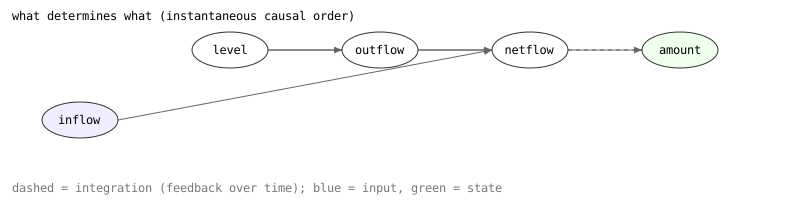
The inflow is an input (blue); the amount is the state variable (green) that carries the system's memory; everything else is computed from them at each instant. The dashed arrow is integration — the net flow feeds back to change the amount over time, which is the loop that drives the whole behavior.
Exercises
- Add a second drain to the bathtub: a variable
outflow2that also rises withlevel, and fold it into the net-flow balance. Which constraints do you add or change? (Hint: you'll need the net flow to subtract both outflows.) - Explain in words what
MMinus("pressure", "volume")asserts about a gas. - Why does the model use
Deriv("amount", "netflow")rather thanDeriv("level", "netflow")? (Which quantity is the one the net flow literally accumulates into?)